My Portfolio
In both storytelling and learning design, showing is better than telling.
Below are some examples I have created using various tools and processes and to meet different learning goals.
Simulations and Fidelity Trainings
Form Fidelity
A common product I build can be referred to as “Fidelity” or “Compliance” Trainings. When it is crucial for users of a process to complete the process exactly like each other user, I often use Articulate Storyline to replicate the process, scaffolding the information with interactive elements. Users must complete each step and are provided specific feedback based on their mistakes while modeling the correct behaviors. The following are two examples of interactions in which the user fills out a simulation of the form, and the form gives specific feedback based on which error the user made. Both are part of larger training modules that model other parts of the specific system processes (like information collection and in-person interviews).
Risk Assessment
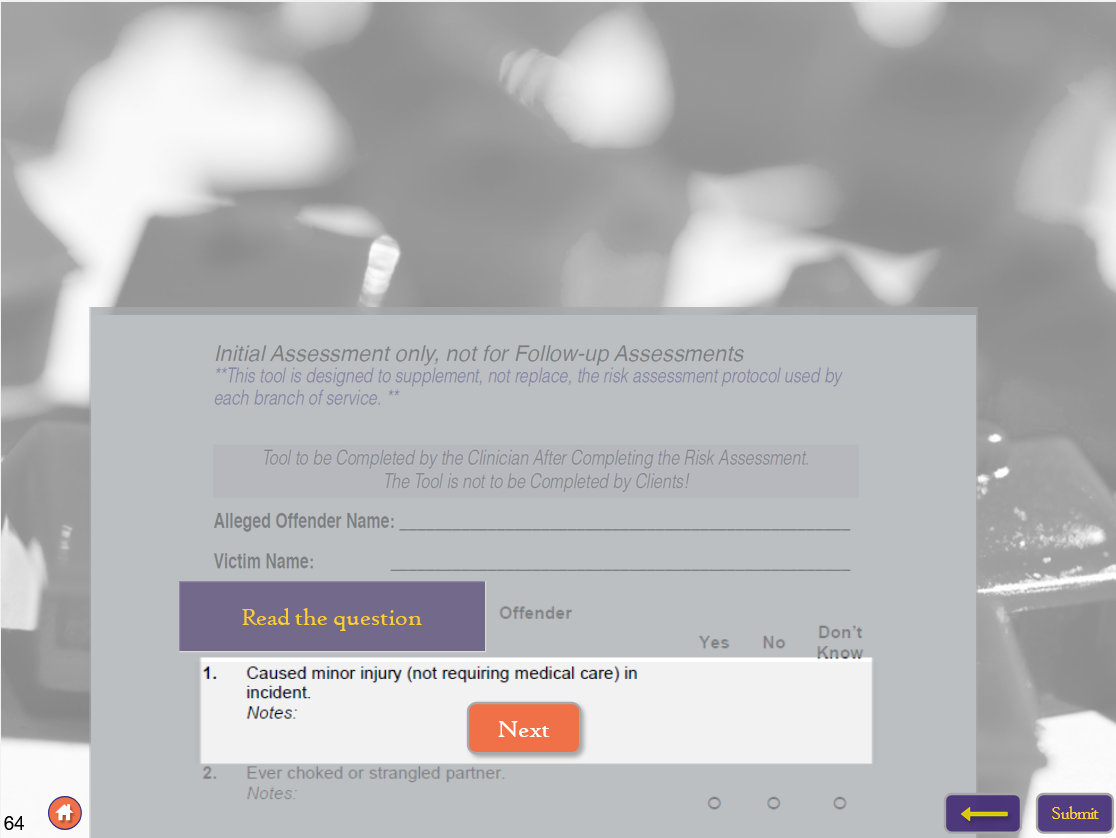
This training was used to teach clinicians how to properly use a new intake form to assess for the possibility of domestic abuse.
This interaction was the final part of the training, where the user completed an interactive interview, and their notes were recorded to be used in this section to fill out the form. Notice how the interface is scaffolded. The purple instruction boxes guide the user through the interface one step at a time so it is easy to understand how to interact with the module.
Problematic Sexual Behaviors Assessment Tool
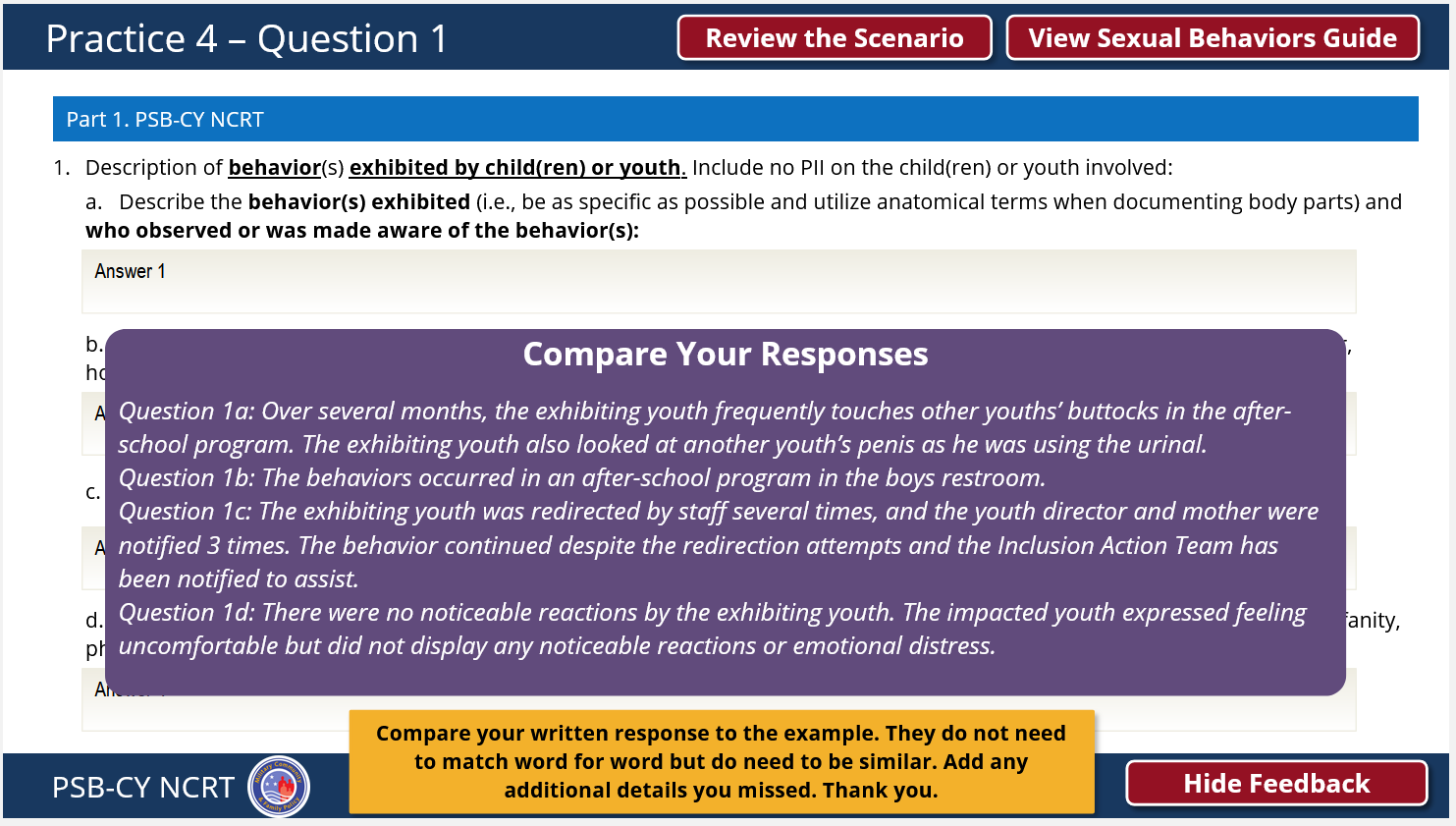
The goal of this training is to teach clinicians how to use a tool to assess problematic behavior in schools.
As the user goes through this scenario, they must fill out the tool as they would in the field. The purpose of this tool is to make sure everyone fills it out the same way, so giving feedback even in this asynchronous module was essential. Click few a few pages, and notice how the users gently prompted with specific feedback and suggestions depending on which part they are getting stuck on.
Simulations
Articulate Storyline is an incredible tool for creating custom simulations of complex processes. I created a product in which the goal was to completely replicate HVAC systems to train learners on how to assess malfunctions. I created simulators which have interactable points that manipulate output displays. These displays then change depending on the user interaction and where the simulator is on a resettable time loop. This combination requires consideration of time, interaction, animation, and changing variables. Thousands of triggers were needed to effectively, and efficiently, simulate an HVAC system. Then, each malfunction of the system had to be coded in separately so I had to be extremely efficient to meet the client’s timeline.
These products are contained within Storyline projects that provide further context and use workbook style scaffolded learning. While it may be difficult to understand what the system is doing without the content, you can click around within the examples to see just how many interactions and moving parts there are in both of these HVAC systems.
HVAC Heating
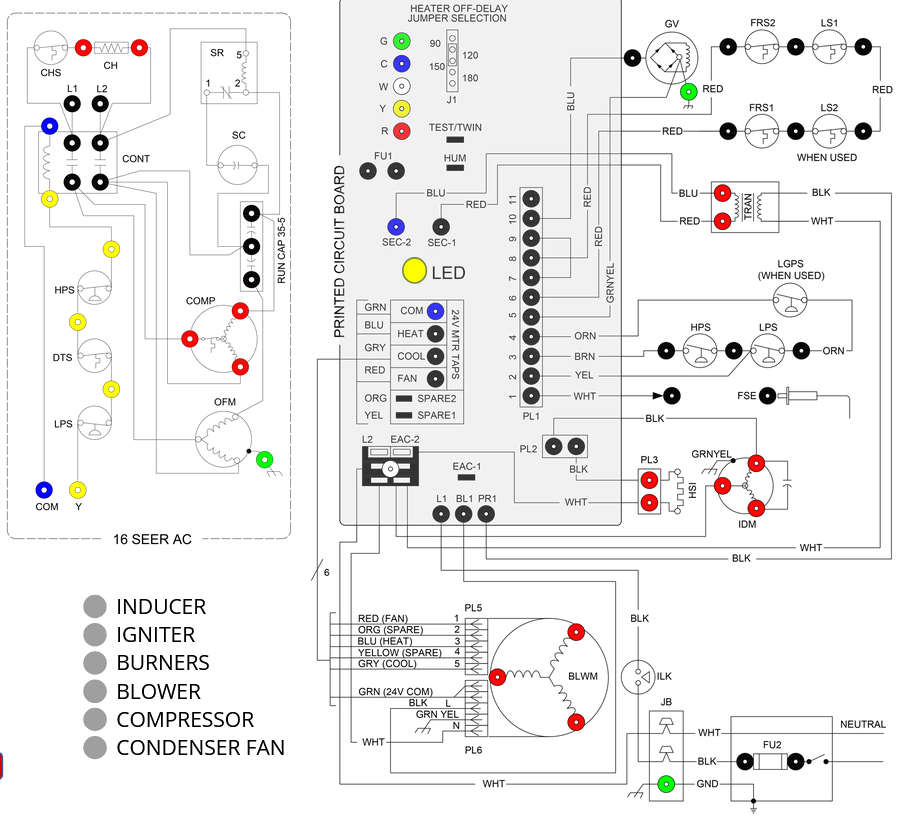
When building this situation, I ran up against the boundaries of what could be built in Storyline. I overcame many issues by using layers to hold triggers like a style sheet in CSS, and using states of things almost like layers.
Then, when I had too many triggers and Storyline wasn’t able to publish the product, I had to figure out how to do the same thing again in a different way with fewer triggers, layers, and states. This build was a frustrating, but satisfying puzzle that helped the client transition from an only in-person training model an online model.
HVAC Cooling
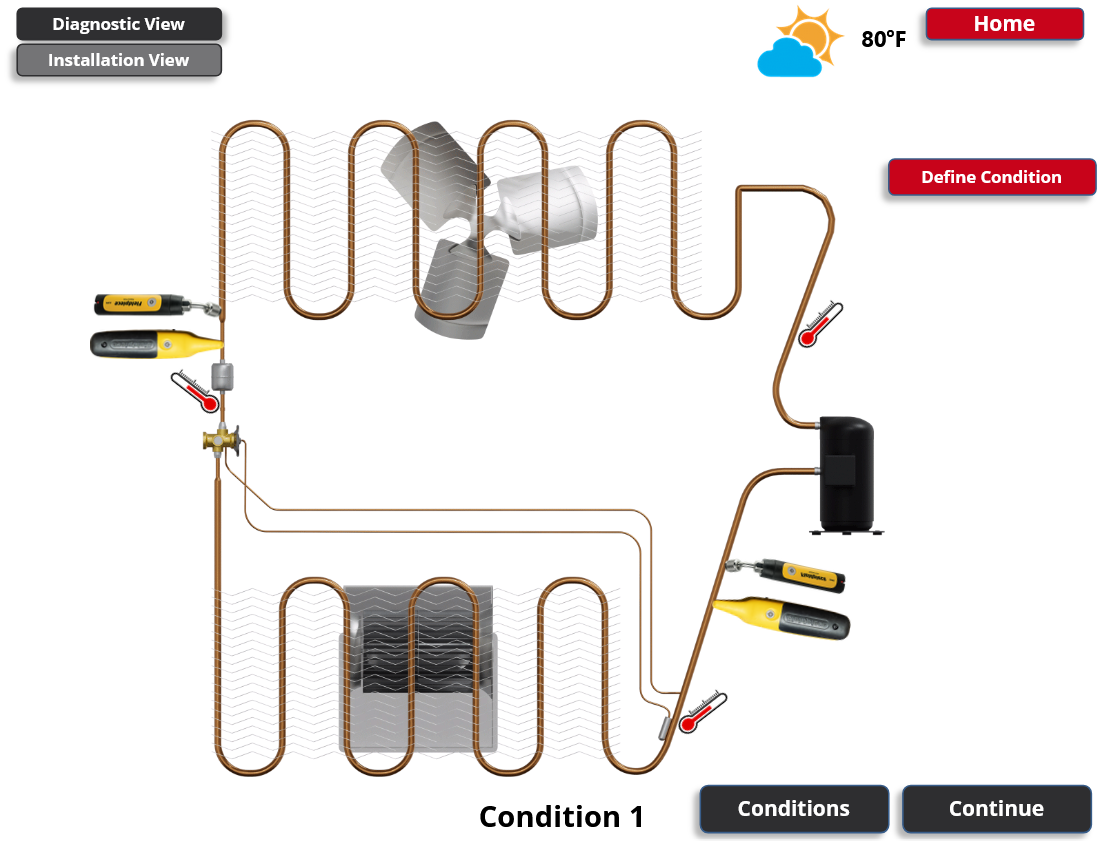
In an HVAC cooling system, the devices that analyze the state of the system display a stream of ever-changing numbers. This module was interesting because I had to figure out a way to have a series of ever-shifting numbers as well as a way to have those stream of numbers change based on malfunctions in the system.
The method that eventually worked was creating videos, then GIFs, of those streams of numbers and using some layering techniques within Storyline to situate those GIFs in the proper place.